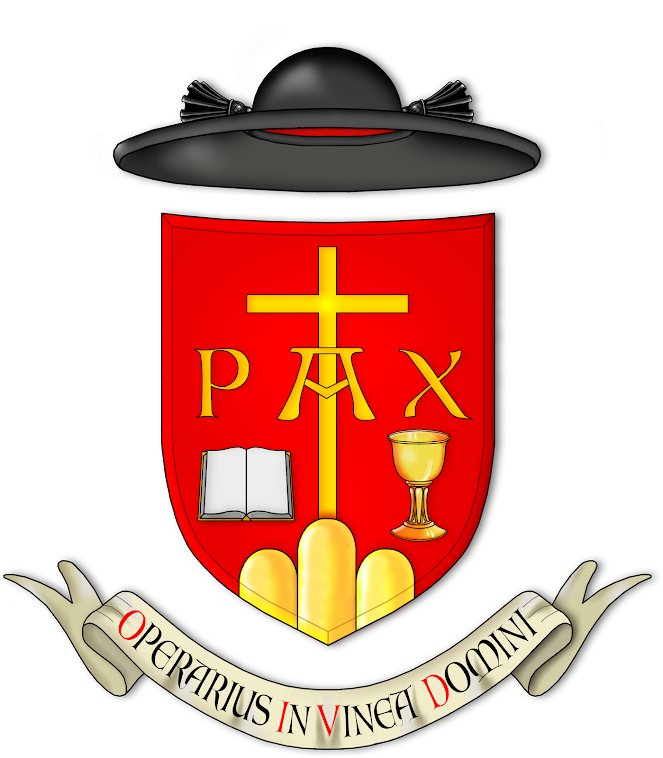
Allow me again to apologize for the dearth of postings in this space in the previous weeks. Ideally, I'd love to be able to post two or three times per week here, to give those of you who might be inclined to read a better idea of how the formation process is going. I have a paper that will be due at some point next month, and the topic that I have chosen is the development of Trinitarian Doctrine. As of yet, I have not started the paper, and those of you who know me know that to be more than a bit unusual, normally I begin assignments immediately, so as not to give in to the temptation to procrastinate. Part of this is due to the fact that I didn't get approval from our instructor, Robert Feduccia, for my topic until this past Sunday. Lest anyone think I am blaming Robert for that, I certainly am not-I suspect he has some of the same issues with schedule and time that the rest of us do. He came all the way from Oregon just to teach us, and I am very grateful for that indeed. I was given a perspective on the Trinity that changed forever the way I will view the God we serve, and will certainly increase my devotion to the Most Holy Trinity.
Just this past week, I had a dear friend from my own parish tell me that despite having a deep interest in the deaconate, he didn't go through with the application process because he came to the conclusion that there is no way that between his work schedule and his family commitments that he felt that he could take on the responsibilities that are required of him. This saddened me because I know how committed this person is to the Church and to our parish-indeed in my own mind, this person does more physical work for the parish than I could ever do. However, I have also learned through the experience of formation that time is at a premium. Just because I am in formation does not mean that my secular life can just grind to a halt-this is one of the great tests of formation and one of the ironies (if you will) of the deaconate. You might have seen me write of my administrative responsibilities at the fire department before. It is appropriations time, and I am on a time crunch deadline to complete that process by the end of next week before I leave for our formation weekend (forms and budget are due in Monday morning Feb. 6th, and formation is next weekend). I would love to take about four days away from the office next week to devote to research for our paper and prayer. The Fire Chief knows I am in formation (although like most people in these parts, he isn't Catholic so what the process involves is not something he or most other folks here would be familiar with) and if I tell him "I will be away for a day or two while I work on deacon things," he normally doesn't care-he knows that I take care of things in the office. This is a time, however, when he can't spare me as much, and I need his help as well. As a result, I need to meet with him regularly during a week like this one to make sure our fiscal ducks are in a row. Nevertheless, the ability to balance Church and spiritual life and one's secular responsibilities is a critical part of the deaconate-deacons live Holy Orders in the secular world.
St. Lawrence the Deacon
I had my first meeting with my Spiritual Director this weekend. I know you'll understand that I'm going to keep much of what we discuss between us, but I took note of the commonality between us when it comes to two things-a very tight schedule, and a keen interest in the sporting world. I took many things away from our first discussion at length, but I also came away feeling blessed. I may never again complain about being pressed for time, for my spiritual director is a man who, frankly, has no time but somehow manages to be a deacon who is a model for the diocese, and for the rest of us, and for me.
Pray for all of us in formation-Lord knows, we need it.
Friday, January 27, 2012
Saturday, January 14, 2012
The Holy Trinity
Firstly, I want to apologize to those of you who have become regular readers of this weblog (that number is still admittedly small but growing) that I have not posted since the New Year. I have had an extremely busy week, and it had been my intent to post something this past Friday before leaving for deaconate formation, and it didn't quite work out as I had wanted-I just ran out of time. That's something that seems to be epidemic lately, and no, that isn't a complaint, it is just the way things are.
Our formation weekend was packed with material, and my mind is still somewhat on sensory overload from all that we learned. What's more, we have a seven page paper, give a few here and there, that will be due in about a month and a half in which we have to choose a topic where we can prove a theological idea from the writings of the Church Fathers as well as from the ideas of a more modern biblical scholar...oh, and next month, we will have our first exam. It has been a long time since I have had to take an exam, so I am a bit nervous about it. Nevertheless, the material we talked about this weekend was so important that I see the need to be tested on it. Robert Feduccia, currently of Oregon Catholic Press (Spirit and Song) and formerly the youth coordinator and vocation director at St. Meinrad Archabbey (to which I am pledged as an Oblate of St. Benedict) was our instructor for the weekend. The topic was the Holy Trinity-something that I learned more about this past weekend than I ever knew before, and in the name of brevity and because I am exhausted, I can't really give a typical overview in one post as I have done in the past, so I'll have to break some of the finer points into multiple posts.
We discussed the arguments of the atheists and secularists, which are quite pervasive, and as Robert pointed out, even though so many of our people in this country claim to believe in God, so few by comparison act on that belief. At least we are better off than Europe, which has surrendered itself completely over to an unabashed secularism and unbelief. However, if we do not change the tone of the culture and take our place at the forefront of the debate over the increasing secularization of our country, we will soon be headed in the same direction, as the statistics bear out that the millennial generation is inherently unchurched and seems inclined to be so.
The Blessed Trinity has been the matter of dispute within Christendom precisely because it is difficult to explain to anyone the idea that we only worship one God, but that God consists of Three Divine and Distinct Persons (Father, Son, and Holy Spirit). Further, Christ was begotten, not made, and was born of the Father before all ages (there was never a time when He was not). Christ is of one substance with the Father (consubstantial) and the Holy Spirit proceeds from the Father and the Son-the Father is God, the Son is God, the Holy Spirit is God. These Persons are not types of God and they are not mere modes of the one God, but are Persons distinct and divine, but exist as one God, as hypostasis-real and distinct Divine Persons in an undivided Unity of God. If that sounds confusing to you, it was to Arius, which is why he came up with the idea that Christ was an intermediary to God, had no human soul, and was not equal to the Father (and therefore not Divine). Arius' ideas weren't far-fetched, which is why they were widely accepted-they were an easy way to explain a complex theological question. The difficulty is that Arius and his followers ultimately denied that Jesus Christ is God, and it was that dangerous notion-that Jesus Christ is not fully Divine and of one substance with God the Father-that led to the Church's ultimate adoption of the Nicene Creed as the profession of faith of Christians.
Is the Trinity hard to understand in our human terms? Sure it is. We literally profess to believe in one God (Deutoronomy 6:4-9), but we say that the one God consists of three separate and distinct Divine Persons who are still of one substance and who act as One in a Unity of Love which existed before all ages. Christ, as the Divine Word, is the second Divine Person of this Godhead (John 1:1-4). It isn't easy to put one's arms around this idea, so it is easier to say, as Arius did, that Christ could not possibly be Divine.
Who said the Faith of the Church was meant to be easy?
Saturday, December 31, 2011
The New Year
As we prepare to leave one calendar year behind and enter another, the Church always celebrates the Feast of Mary, the Mother of God. It is also usually a time to reflect on the year that has passed and the new one that is about to begin. For me, a lot of things have happened in 2011, but the deaconate formation process has not only defined my year and changed, I would say, the very spiritual complexion of our home, it has changed forever the way that I view the Church's role in my daily life. The interesting thing about that statement is that when I began the formation process, I really had no idea of the transformative impact that it would have on not only my life, but our home, and the way that I have noticed that I am perceived by others-that is something that Deacon Jim Prosak, my mentor, told me that I would see happen more and more as the time passed.
I am finding also that I have an increased desire to pray more of the Divine Office whenever my schedule permits it. I regret that I cannot honestly say that I am praying at least five of the seven hours-the five which are required of priests-every day, but I now try to pray five of the prayers of the office every day. The "Big Five" are the Office of Readings (Matins), Morning Prayer (Lauds), Daytime Prayer Current (Sext), Evening Prayer (Vespers), and Night Prayer (Compline). The other two hours are Terce, called Midmorning Prayer in our modern tongue, and None, or Midafternoon Prayer.
The names of the three Daytime Hours tell us precisely when they are supposed to be prayed, Terce, or the third hour of the morning watch-9:00AM. Sext, the sixth hour-Noon. None, the ninth hour, also the hour Our Lord expired on the Cross-3:00pm. Our lives don't fit nearly as neatly into those little boxes in modern times-even some monastic communities do not pray the Hours on the strict timing that had become the Church's custom over the years (some, like the Cistercians, still do keep the Hours largely at the traditional times). As a result, the Church wants us now to pray Morning Prayer in the morning, Daytime Prayer during the breaks in our day, Evening Prayer in the evening, and Night Prayer at night before bed. The Office of Readings can be prayed at any time during the day that we can find the time, and the Office of Readings may begin the liturgical day and come before Morning Prayer if someone is so inclined. I often either like to combine the Office of Readings with Morning Prayer or with the Daytime Hour, depending on my schedule on a particular day. If I am up after midnight, I will sometimes pray the Office of Readings by itself.
If, by the Lord's grace, I make it to ordination, I, along with my Brother Aspirants will pledge to pray Morning and Evening Prayer every day. My position as a Benedictine Oblate already requires of me to pray Night Prayer. Yet, I have felt called recently to pray the Office of Readings and Daytime Prayer in addition to the Hours I had been praying. I find myself offering up each psalm or canticle or reading for some intention I might otherwise have forgotten in my human weakness. For a Brother Aspirant or wife who needs my prayers, for a friend who is ill, for those I know who need help that I cannot give beyond my prayers, for my vocation and for the guidance of the Holy Spirit in discernment, and the same for my fellow Aspirants, for my mentor, and spiritual director...name that need. The more time that I have found to pray, the more prayer intentions and needs I seem to be able to remember.
If I could stress anything to people throughout the Diocese, it is that they can and should be proud of the exceptional class of men who are in formation for the deaconate. I pray each day for these, my brothers, and I often think myself to be the least worthy of all to be among their number. This is the vigil of the Feast of Mary, the Mother of God, and I have resolved to commit my own vocation and the entire formation class to the Immaculate Heart of Mary.
Mary Immaculate, Mother of God and perfect Christian, you treasured the word of God, in faith you pondered it in your heart and acted on it in charity and service.
As we all move into the New Year, I would simply ask that readers remember not only me, but all of the Aspirants for the Deaconate in the Diocese of Knoxville and in the Hily Catholic Church throughout the world in your prayers.We know that as children of God and believing Christians, God's love is given to us, "...the love of God has been poured into our hearts by the Holy Spirit which has been given to us." Your heart as symbol of your love for God, for us, and for all creation, reminds us that "as long as we love one another God will Live in us And His Love will be complete in us."
Saturday, December 24, 2011
Nativity Thoughts
Christmas Eve usually puts me in an interesting predicament because I can't keep a secret from Nicole. She already knows what she is getting for Christmas, largely because I can't ever go to the store without her to begin with. She got exactly what she asked for (some horseshoeing tools in order to shoe her own horses rather than hire a farrier to do it, which is a major expense that we can't really afford). Nicole loves horses, which is normally a very expensive hobby, and one that I certainly wouldn't be able to finance, except that we've been blessed in this way by the right people seeming to cross our path who share Nicole's love for these beautiful animals. One horse was free, the other was cheap (as in very inexpensive). What is even more remarkable is that these "giveaway" horses both come from good bloodlines, and those people who really know horses can tell this. Nicole found a place to board her horses-the home of a very nice lady whose lone horse needs companionship in the pasture (horses are herd animals). Hence, board also costs us very little compared to what people normally pay. Because of all these things, I feel blessed that Nicole is able to own, ride, and take care of two fine horses at so little cost to us-largely because the Lord blessed us (and specifically her) with meeting the right people who shared her passion for things equine and could help her keep a foot in the horse world.
How all of that relates to Christmas is that Nicole's Christmas requests in recent years almost always relate to horses and horse-related things. It is impossible for me to hide a Christmas present from her-she almost always knows what she is getting, and this year is no exception-she asked for shoeing tools and she will get them. Me, on the other hand-I have no idea what I am getting, and she has the secret well-hidden-something she seems able to do with great success every year. I have gotten to a place in my life where I rarely ask for much in the way of gifts at Christmastime, because I am thankful for the things that I have, and there always seems to be so little that I actually need, and I thank the Lord for that.
It is entirely too easy-and I know that many people say this every year so that it becomes almost cliche-to become caught up in the material aspects of this time of the year. Indeed, we know that our society has become so obsessed with both the material and the commercial aspects of what we have come to call the "holiday season" that people bring out the Christmas decorations and the carols and the associated bon vivant at Thanksgiving weekend and sometimes before. There is no preparation of heart and mind for Christmas, so that when Christmas does come, people have a meal, open presents, and then quickly in their minds move on to other things the next day. When I wished a Merry Christmas to a friend of mind last year on December 27th, he wondered why..."Christmas is over," he said. It is not over at that time, of course, it has just begun.
We still have traces-albeit ever smaller ones-of what Christmas is really about within our culture, but Americans have lost (and many never had) the idea that Christmas is a season, and not a single day that we get excited about for a month (this comes from the Puritan heritage within this country-we do not have a true tradition of Christmas as Americans, it wasn't even an official holiday until the 1880's). That season does not end on December 25th, it begins on the 25th, and actually begins tonight at vigils for Christmas. Many people do not prepare themselves for Christmas by truly celebrating and living Advent before we get to the point of tonight. We need Advent because of what exactly it is we are preparing to celebrate and commemorate. We need time to reconcile in our minds how what we commemorate reconciles-or is radically opposed to-our materialistic culture of today.
We have our romantic notions of nativity scenes and singing Away In A Manger and Silent Night, but do we know of that which we sing? We are celebrating that God was made incarnate in the womb of the Blessed Virgin Mary, and that He was made man, and that He came to us born in a cave used to house dirty farm animals and was laid in a feeding trough used for cattle, and donkeys, and other animals. He came into this world with nothing...nothing. Not as a child of privilege or wealth or power, but as a child born poor amid a backdrop that would make the modern conditions of the poor in our own country look like a vacation in the Hamptons. God chose to manifest himself to the human race as a child born in some of the lowliest possible means that humanity could afford. He came, in his own words (Luke 4:18-21):
That reality-that Christ came to proclaim liberty to captives, preach the gospel to the poor, and give sight to the blind-both literally and, most importantly, spiritually, is what we celebrate at Christmas, and it is the real reason Christmas is-and should be-such a big deal. It's a whole lot more important than a man in a red suit saying "ho-ho-ho."
How all of that relates to Christmas is that Nicole's Christmas requests in recent years almost always relate to horses and horse-related things. It is impossible for me to hide a Christmas present from her-she almost always knows what she is getting, and this year is no exception-she asked for shoeing tools and she will get them. Me, on the other hand-I have no idea what I am getting, and she has the secret well-hidden-something she seems able to do with great success every year. I have gotten to a place in my life where I rarely ask for much in the way of gifts at Christmastime, because I am thankful for the things that I have, and there always seems to be so little that I actually need, and I thank the Lord for that.
It is entirely too easy-and I know that many people say this every year so that it becomes almost cliche-to become caught up in the material aspects of this time of the year. Indeed, we know that our society has become so obsessed with both the material and the commercial aspects of what we have come to call the "holiday season" that people bring out the Christmas decorations and the carols and the associated bon vivant at Thanksgiving weekend and sometimes before. There is no preparation of heart and mind for Christmas, so that when Christmas does come, people have a meal, open presents, and then quickly in their minds move on to other things the next day. When I wished a Merry Christmas to a friend of mind last year on December 27th, he wondered why..."Christmas is over," he said. It is not over at that time, of course, it has just begun.
We still have traces-albeit ever smaller ones-of what Christmas is really about within our culture, but Americans have lost (and many never had) the idea that Christmas is a season, and not a single day that we get excited about for a month (this comes from the Puritan heritage within this country-we do not have a true tradition of Christmas as Americans, it wasn't even an official holiday until the 1880's). That season does not end on December 25th, it begins on the 25th, and actually begins tonight at vigils for Christmas. Many people do not prepare themselves for Christmas by truly celebrating and living Advent before we get to the point of tonight. We need Advent because of what exactly it is we are preparing to celebrate and commemorate. We need time to reconcile in our minds how what we commemorate reconciles-or is radically opposed to-our materialistic culture of today.
We have our romantic notions of nativity scenes and singing Away In A Manger and Silent Night, but do we know of that which we sing? We are celebrating that God was made incarnate in the womb of the Blessed Virgin Mary, and that He was made man, and that He came to us born in a cave used to house dirty farm animals and was laid in a feeding trough used for cattle, and donkeys, and other animals. He came into this world with nothing...nothing. Not as a child of privilege or wealth or power, but as a child born poor amid a backdrop that would make the modern conditions of the poor in our own country look like a vacation in the Hamptons. God chose to manifest himself to the human race as a child born in some of the lowliest possible means that humanity could afford. He came, in his own words (Luke 4:18-21):
"The Spirit of the Lord is upon me, because he has anointed me to preach good news to the poor. He has sent me to proclaim release to the captives and recovering of sight to the blind, to set at liberty those who are oppressed, to proclaim the acceptable year of the Lord." And he closed the book, and gave it back to the attendant, and sat down; and the eyes of all in the synagogue were fixed on him. And he began to say to them, "Today this scripture has been fulfilled in your hearing."
That reality-that Christ came to proclaim liberty to captives, preach the gospel to the poor, and give sight to the blind-both literally and, most importantly, spiritually, is what we celebrate at Christmas, and it is the real reason Christmas is-and should be-such a big deal. It's a whole lot more important than a man in a red suit saying "ho-ho-ho."
Monday, December 19, 2011
A tale of two lives
This past week has been a week of high-profile deaths. John Patrick Cardinal Foley, who was the former chief of the Pontifical Council for Social Communications and who had a passion for communicating the Gospel to others, died December 11th, and his Mass of Christian Burial was this past week. Most of us knew Cardinal Foley as the "Voice of Christmas" who provided the English language commentary and translation of the Midnight Mass from St. Peter's Basilica every year (he did the same for the Easter Mass from St. Peter's Square) on television to a global audience. For many people, their annual encounter with the Eucharistic Lord on their local NBC station on Christmas Eve was the only time they saw Jesus (and we do mean they saw Jesus in seeing his Body and Blood under the appearance of bread and wine) on television or anywhere else. Cardinal Foley sometimes gently reminded people that the Lord was truly present.
Cardinal John Patrick Foley
For many of the world-wide audience who would listen to Cardinal Foley's voice, he was the only exposure they ever had to the Catholic faith. Doubtless for some, he was their first exposure to it, and although I certainly did not know or think of it at the time, he was probably my first exposure to Catholicism and to what a Mass looked and sounded like. He spent his life finding ways to spread the Gospel of Christ through modern media and social communications. Many souls were surely reached for the Church and for Christ through his tireless ministry in the media.
Someone else passed away this past week who often used the media for very different ends than did Cardinal Foley. Christopher Hitchens was a man of immense intellectual gifts and was a great writer, commentator, and orator. I very often disagreed with Hitchens, but I had a great admiration for his intelligence and wit, and would read, watch, and listen to him often just to get a dose of it. Hitchens had one major problem, however: He hated God, Christ, Christianity, and the Church. He certainly spent an inordinate amount of time attempting (without much success) to defame Blessed Mother Teresa of Calcutta.
Christopher Hitchens
Hitchens' brother Peter is a Christian and a social conservative, as well as a gifted award-winning journalist and writer (he literally became the Christian counterweight to Christopher whether he intended to or not). Christopher Hitchens' official position was that God did not exist, but his speeches, media appearances, and writings belied another reality in his head: That he knew God existed, and was just mad at God. When talking about issues of the Divine, his tone often moved from the satirical to the very angry.Indeed, when I think of the kind of atheism marked by anger at God described by Cardinal Kasper in our assigned reading for next month, The God of Jesus Christ, I can't help but think of Christopher Hitchens. He has crossed my mind several times while reading The God of Jesus Christ.
I have met few so-called atheists who, after my encounters with them, did not leave me feeling as though they actually DO believe in God/Higher Power/Divine Presence, but they refuse to admit this because the reality is that they are angry at God-usually for a multiplicity of things that can be chalked up as a direct or an indirect result of human fault, sinfulness, or frailty. (i.e. "Why would a loving God allow so much death in the world/war/destruction/my relative(s) or friend(s) to live or die in such a horrible way/name that social problem").
Christopher Hitchens was a master of this tired old argument. Indeed, he was one of the best at it that I know of, primarily due to his humor and wit. However, Hitchens left me on several occasions after listening to him with the distinct impression that his resistance to God was based less on an internalized conviction that God did not exist, and more on an internalized anger with the Almighty, usually stemming from the fact that the world didn't work the way he thought it ought to and this was all God's fault.
An example of this was his debate over religion with former British Prime Minister Tony Blair last year, in which Christopher Hitchens referred to the laws and dictates of God as a "kind of Divine North Korea" because God lays down the consequences of disobedience. The reality is that Hitchens seemed to live a life of rebellion. He did not want to obey God, so he appears to have literally "looked God in the face" as it were, and in his rebellious spirit he said "I do not want obey you, and I do not respect you, so I am going to say that you do not exist, and I am going to preach that to the world."
Even so, the very reason that I hope, nay, pray, that Christopher Hitchens somehow found faith in the last moments of his life is that for all of his vitriole and hatred for the things and the people of God, he was a man of so many gifts. I trust in and believe that the mercy of God is unfathomable and boundless, and extends even to those who have spent their whole lives denying Him, if they, even in but an instant, acknowledge Him and accept His Divine Mercy.
Judging Christopher Hitchens' soul is not my place, but that responsibility belongs to God. This isn't to say that no atheist exists with an internalized belief of conscience that says there is no God-I've met at least one for whom I believe that was actually the case. For those people, they are in for quite a surprise one day. For those like Hitchens, who appear to choose to deny God out of anger or spite or rebellion-I think they know, somewhere within themselves, that they will give answer for all of those years of rebellious denial of Truth.
Christopher Hitchens' life is a reminder to all of us of the words of the first verse of the 12th Chapter of Ecclesiastes:
I pray for them both, and while we can reasonably deduce that Cardinal Foley died in the peace of Christ that he spread to so many others, I pray that somehow Christopher Hitchens was able to recognize that peace and find it as well.
Cardinal John Patrick Foley
For many of the world-wide audience who would listen to Cardinal Foley's voice, he was the only exposure they ever had to the Catholic faith. Doubtless for some, he was their first exposure to it, and although I certainly did not know or think of it at the time, he was probably my first exposure to Catholicism and to what a Mass looked and sounded like. He spent his life finding ways to spread the Gospel of Christ through modern media and social communications. Many souls were surely reached for the Church and for Christ through his tireless ministry in the media.
Someone else passed away this past week who often used the media for very different ends than did Cardinal Foley. Christopher Hitchens was a man of immense intellectual gifts and was a great writer, commentator, and orator. I very often disagreed with Hitchens, but I had a great admiration for his intelligence and wit, and would read, watch, and listen to him often just to get a dose of it. Hitchens had one major problem, however: He hated God, Christ, Christianity, and the Church. He certainly spent an inordinate amount of time attempting (without much success) to defame Blessed Mother Teresa of Calcutta.
Christopher Hitchens
Hitchens' brother Peter is a Christian and a social conservative, as well as a gifted award-winning journalist and writer (he literally became the Christian counterweight to Christopher whether he intended to or not). Christopher Hitchens' official position was that God did not exist, but his speeches, media appearances, and writings belied another reality in his head: That he knew God existed, and was just mad at God. When talking about issues of the Divine, his tone often moved from the satirical to the very angry.Indeed, when I think of the kind of atheism marked by anger at God described by Cardinal Kasper in our assigned reading for next month, The God of Jesus Christ, I can't help but think of Christopher Hitchens. He has crossed my mind several times while reading The God of Jesus Christ.
I have met few so-called atheists who, after my encounters with them, did not leave me feeling as though they actually DO believe in God/Higher Power/Divine Presence, but they refuse to admit this because the reality is that they are angry at God-usually for a multiplicity of things that can be chalked up as a direct or an indirect result of human fault, sinfulness, or frailty. (i.e. "Why would a loving God allow so much death in the world/war/destruction/my relative(s) or friend(s) to live or die in such a horrible way/name that social problem").
Christopher Hitchens was a master of this tired old argument. Indeed, he was one of the best at it that I know of, primarily due to his humor and wit. However, Hitchens left me on several occasions after listening to him with the distinct impression that his resistance to God was based less on an internalized conviction that God did not exist, and more on an internalized anger with the Almighty, usually stemming from the fact that the world didn't work the way he thought it ought to and this was all God's fault.
An example of this was his debate over religion with former British Prime Minister Tony Blair last year, in which Christopher Hitchens referred to the laws and dictates of God as a "kind of Divine North Korea" because God lays down the consequences of disobedience. The reality is that Hitchens seemed to live a life of rebellion. He did not want to obey God, so he appears to have literally "looked God in the face" as it were, and in his rebellious spirit he said "I do not want obey you, and I do not respect you, so I am going to say that you do not exist, and I am going to preach that to the world."
Even so, the very reason that I hope, nay, pray, that Christopher Hitchens somehow found faith in the last moments of his life is that for all of his vitriole and hatred for the things and the people of God, he was a man of so many gifts. I trust in and believe that the mercy of God is unfathomable and boundless, and extends even to those who have spent their whole lives denying Him, if they, even in but an instant, acknowledge Him and accept His Divine Mercy.
Judging Christopher Hitchens' soul is not my place, but that responsibility belongs to God. This isn't to say that no atheist exists with an internalized belief of conscience that says there is no God-I've met at least one for whom I believe that was actually the case. For those people, they are in for quite a surprise one day. For those like Hitchens, who appear to choose to deny God out of anger or spite or rebellion-I think they know, somewhere within themselves, that they will give answer for all of those years of rebellious denial of Truth.
Christopher Hitchens' life is a reminder to all of us of the words of the first verse of the 12th Chapter of Ecclesiastes:
Remember also your Creator in the days of your youth, before the evil days come, and the years draw nigh, when you will say, "I have no pleasure in them."What a difference in lives. One of these men spent his life using the modern media to spread the Gospel, while the other very often used those same media to try and undermine it.
I pray for them both, and while we can reasonably deduce that Cardinal Foley died in the peace of Christ that he spread to so many others, I pray that somehow Christopher Hitchens was able to recognize that peace and find it as well.
Thursday, December 15, 2011
Called by name
Two of the most important people in our deaconate formation process in the Diocese of Knoxville (and I would imagine in any diocese) other than our wives and the Director of Deacons are our deacon mentor and our spiritual director. We had some say in who our spiritual director would be (mine is Deacon Patrick Murphy-Racey, who I hope and pray to meet with as soon as he is able. His blog is one of those listed on this site), but our mentors were chosen for us. This past Sunday, I met with my mentor, Deacon Jim Prosak of Holy Trinity Parish in Jefferson City, for the first time.
I know you'll understand that it is in the best interest of myself (and most probably in the interest both of Deacon Jim and the formation process itself) that I keep the lion's share of what Deacon Jim and I discuss between the two of us. However, I'd be remiss if I didn't share the one thing that Deacon Prosak told me that stuck with me, and which I have thought on rather extensively since Sunday.
We talked extensively about the formation process, and some of the intricacies involved, from the academics to the general differences between his formation process-he was in the previous class-and the current one. The idea that this call to the service of the Church which I and the other men in formation are experiencing is a matter of discernment is something that we discussed at length. Deacon Jim said that he was not absolutely sure and certain that the Lord was calling him to the deaconate until he was on the required 5-day canonical retreat that we all must take shortly before we are ordained. "I was fully prepared to come back from that retreat and not be ordained," he told me. He said he wasn't sure at that point whether what he was experiencing was the call of the Holy Spirit or whether it was "what Jim wanted to do."
Deacon Jim shared that it was while on retreat during a time of private prayer and meditation on the scriptures that the Holy Spirit made it very clear that he had been "called by name" to the deaconate and the Sacrament of Holy Orders, and that he had come that far because it was truly God's will for his life. Deacon Prosak returned from the retreat as a man who was ready to assume both the blessings and the burdens of a deeper ministry in the Church.
As I shared with Deacon Jim, I have already had plenty of experience as part of this discernment process wrestling with the question of whether this is a matter of the Holy Spirit moving me toward ministry or whether it is just me tooting my own horn. I've certainly had plenty of times where I have thought "these other guys are much holier than me-surely I don't belong here with them." I've even had what I consider to be attacks of Satan, who has spun his wicked powers of persuasion a time or two in an attempt to try and convince me that I am too crippled and weak to perform the tasks which will be required of me should I be ordained. However, every time I get discouraged, I also get an immediate nudge from the Holy Spirit telling me "I have put you here for a reason, and you need to quit worrying about your limitations or about your worthiness and start worrying about what I am asking you to do." These interventions of the Holy Spirit very often come in the form of a single question: "Have I failed you yet?" He never has before, and I doubt He is going to start now.
Even now, not knowing what lies at the end of this road, I feel that the Lord is calling me out by name. My prayer is that I continue throughout the formation process to follow His voice, and lean not on my own understanding.
Saturday, December 10, 2011
The new Roman Missal and the Divine Office
Since the universal Church has plunged into the new translation of the Roman Missal on the first Sunday of Advent, several questions have arisen about the place of some of the prayers of the Roman Missal in the Liturgy of the Hours, since there are certain prayers that the English translation of the Liturgy of the Hours and the English Translation of the Missale Romanum have traditionally held in common. Some of the concluding prayers on certain days of the week are traditionally the same prayers used at Mass that day-especially on the feast days of particular saints. The most obvious example of a prayer held in common is the use of the Confiteor or the Kyrie during the Penitential Act at Compline (Night Prayer). The English translation approved for use in the Liturgy of the Hours has not changed as of yet, and it dates to 1974 and first came into common use in the Anglosphere in 1975. The translation used in the English-speaking world is nearly universal, with the Grail translation of the psalms and canticles being used in every version in every English-speaking country.
The only difference between the editions issued for the United States and Canada and those issued for the rest of the world is that the U.S. and Canadian editions of the Office use the New American Bible as the translation for Scripture readings, while editions issued for the U.K., Ireland, and Commonwealth countries use the Jerusalem Bible and a few other English translations, including the Revised Standard Version, for Scripture readings. However, many web sources such as Divine Office, which intend to be faithful to the approved English translation of the Liturgy of the Hours are using the old versions of the Confeteor and Kyrie responses. Should they?
Although he is a layman, Jimmy Akin has done a fair amount of research into this issue for his podcast in order to answer a listener's question about the use of the new Mass translation outside of the Mass-especially where the Liturgy of the Hours is concerned. I've provided the link above in-text so that readers to this blog can have a listen at what Jimmy has been able to find out, but it would appear that we can begin to use the responses and prayers from the new Roman Missal where they are appropriate to the Liturgy of the Hours (i.e. Mass prayers, Kyrie, and Confeteor, etc.), including in group settings ("And with your spirit.") Indeed, we were using "and with your spirit" during the Office for formation last weekend. The changes in the Missal have given rise to the larger question: Will the English translation of the Liturgy of the Hours also be changing?
It seems to be the consensus of the folks who follow such things that the English translation of the Hours will eventually be changing, and that many of us who are currently in formation for the deaconate or the priesthood (and who will thus be bound by ecclesiastical promise to pray the Office every day for the rest of our earthly life) will live to see whatever changes may be implemented impact our daily prayer life-certainly the changes to the Missale Romanum already have done just that. However, it ought to be remembered that the Latin revision to the Missale Romanum was approved in 2000, and we are seeing its implementation in our own tongue nearly 12 years after the approval of the initial text. To my personal knowledge, an official revision to the Latin text of the Liturgy of the Hours has yet to be approved by the Congregation for Divine Worship and the Discipline of the Sacraments.
The text of the Divine Office which we currently use will continue to be the version that we use for the foreseeable future then, even as we embrace minor changes to it that are related to the changes we are experiencing in the Mass.
Subscribe to:
Posts (Atom)


